13 January 2026
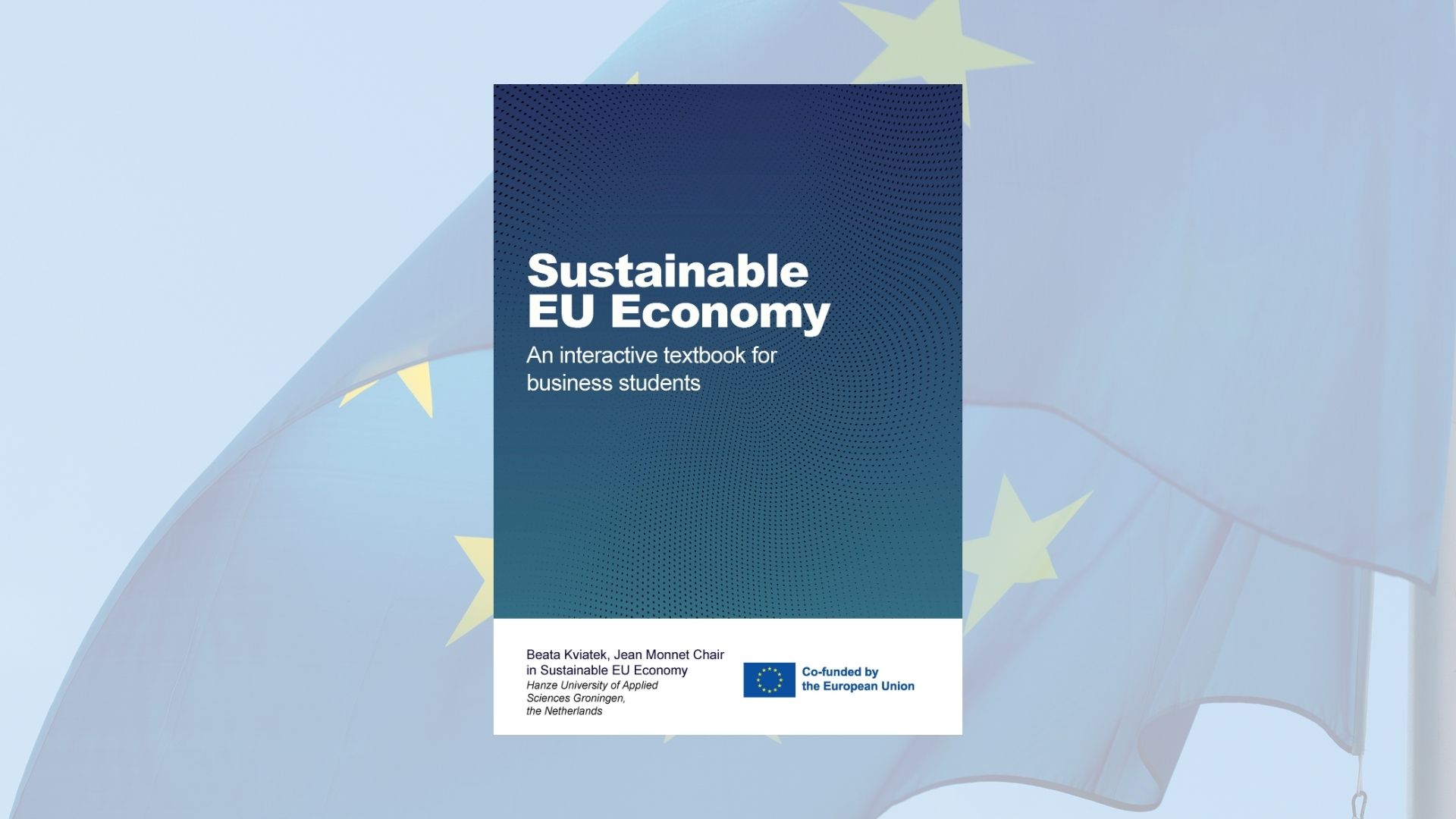
As Europe accelerates its transition toward a climate‑neutral and resilient economy, the demand for clear, practice‑oriented learning resources has grown rapidly. Responding to this need, Hanze University of Applied Sciences introduces Sustainable EU Economy, a new textbook authored by Dr. Beata Kviatek, Jean Monnet Chair in Sustainable EU Economy. The publication offers students, educators, and professionals an accessible and up‑to‑date guide to one of today’s most dynamic policy fields.
Designed for international business and management students, Sustainable EU Economy provides a structured introduction to European integration before guiding readers through the EU’s evolving sustainability framework. Dr. Kviatek describes the book as “an invitation to explore how the European Union shapes business, society, and sustainability in today’s interconnected world.”
What sets the textbook apart is its combination of conceptual explanations, case studies, and interactive links to current policy documents and expert insights. This design enables students to follow real‑time developments in climate policy, energy transition, digital regulation, and social inclusion—areas where traditional textbooks often struggle to remain current.
The textbook is a flagship output of the Jean Monnet Chair in Sustainable EU Economy, awarded by the European Commission and co‑financed by the Erasmus+ Programme and Hanze University. The Chair strengthens education and applied research on Europe’s transition toward a climate‑neutral, resource‑efficient, and socially inclusive economy.
Through expert seminars, applied research projects, and collaboration with policymakers and businesses, the Chair connects local initiatives with EU‑wide goals. The textbook reflects this ecosystem, integrating insights from the 2024 Jean Monnet seminar series on topics such as EU technology law, consumer protection in the digital marketplace, environmental regulation, emissions trading, climate negotiations, and multilevel tax governance.
This connection ensures that the publication is not only academically grounded but also informed by the perspectives of practitioners actively shaping Europe’s sustainability agenda.
One of the central challenges in teaching EU sustainability policy is the pace at which the field evolves. To address this, Dr. Kviatek developed the textbook as an adaptive, interactive resource that remains relevant even as new strategies and regulations emerge.
Interactive links embedded throughout the chapters allow students to explore real‑time policy updates, case studies, and EU documents. Paired with expert‑led seminars and a digital learning environment, the textbook forms the backbone of a hybrid curriculum that blends theory, practice, and current policy analysis. Students work with modules on sustainability, competitiveness, governance, and innovation, supported by live lectures that respond to the latest developments—including major shifts such as those outlined in the Draghi Report.
This blended approach equips future professionals with the analytical skills and strategic insight needed to navigate Europe’s complex regulatory landscape.
While the textbook is designed with students in mind, it also serves as a valuable reference for educators, practitioners, and future leaders seeking to understand the implications of EU sustainability policy for business. “Understanding the dynamics of European business is no longer optional—it is essential,” Dr. Kviatek notes. “My hope is that this book inspires readers to think critically, act responsibly, and contribute to building a sustainable future for Europe and beyond.”
The publication also strengthens Hanze’s position as a frontrunner in applied sustainability education, supporting curriculum development across business programmes and contributing to regional and international innovation initiatives.
To mark the publication, a presentation event will be organized in Brussels, with details to be shared with the Hanze community and external stakeholders in the coming weeks.
In addition, the Hanze will host a dedicated presentation in Groningen, featuring a round‑table discussion on “Building Competences for Europe’s Sustainable Economy.” This session will bring together educators, researchers, and practitioners to reflect on the challenges and opportunities of teaching European integration and sustainability in a rapidly changing political and economic landscape.
A downloadable version of Sustainable EU Economy is available on Edusources.nl.
Learning Europe’s sustainable future—through knowledge, dialogue, and action.