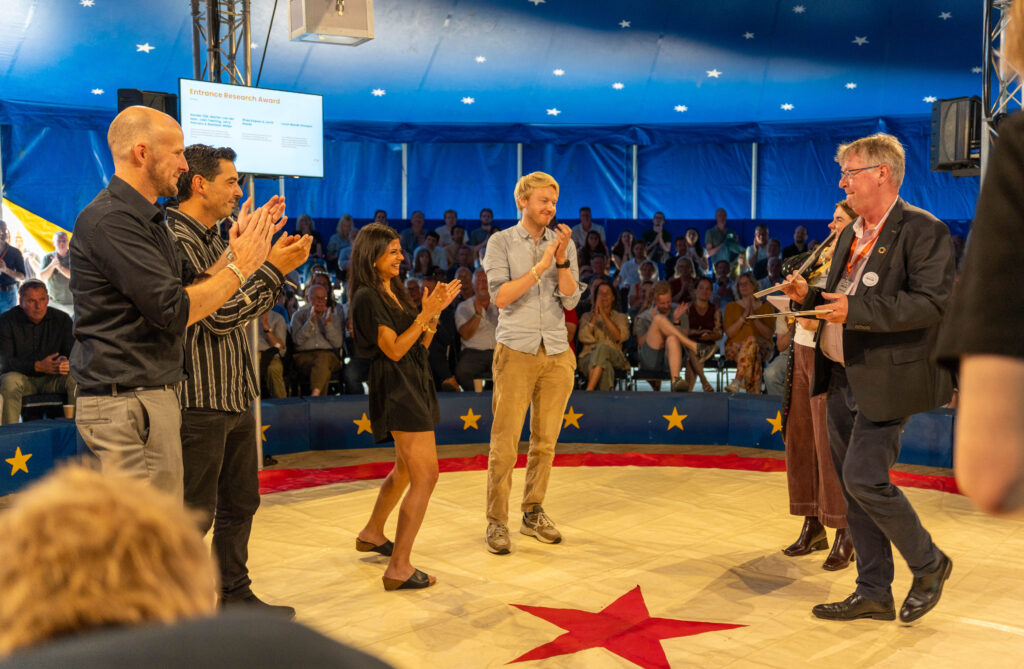
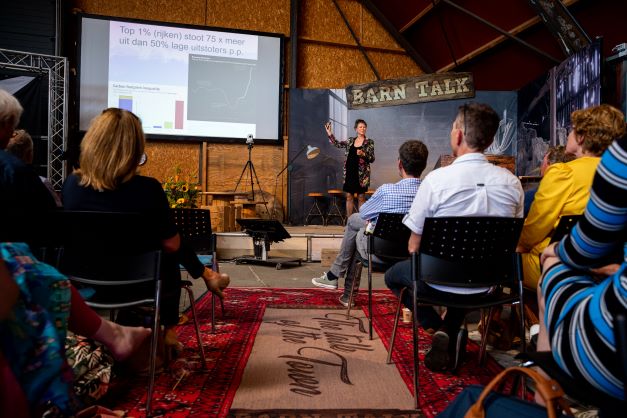
During the academic conference Full Day of Energy & Mobility Transition, part of the New Energy Forum, researchers, students, and professionals come together to discuss key challenges and innovations in the energy and mobility transition. The program concludes with the presentation of the Entrance Research Award. The grand prize for the best paper is €1,500, while the second-place winner receives €1,000 and the third-place winner takes home €500.
The New Energy Forum is known for showcasing inspiring initiatives driven by ambition, innovation, and a willingness to challenge the status quo. The 2025 edition featured an academic program for the first time. Following its success, we decided to expand the program in 2026, and we plan to build on that momentum again in 2027.
The Entrance Research Award recognizes individuals whose research contributes to the energy transition and a more sustainable world. Three prizes are awarded:
The award celebrates outstanding research with the potential to advance innovative solutions and accelerate the transition to a sustainable energy system.
Are you a researcher or a student at a university or university of applied sciences? You can nominate yourself by submitting an abstract of no more than 400 words to abstract@newenergyforum.nl. Abstracts must be submitted in English.
Topics of interest
Abstracts may address a wide range of topics, including but not limited to:
Other topics relevant to the energy and mobility transition are also welcome. All abstracts will be reviewed by a an independent jury, which will select the most promising submissions. The selected candidates will be invited to present their research at the academic conference. During parallel sessions, participants will pitch their work to fellow researchers, students, and professionals.
Evaluation criteria include:
The Scientific Research Conference not only provides a platform for presenting research and exchanging knowledge, but also offers opportunities for publication. Following the publication of the first edition of Breaking Barriers: Accelerating Transitions in 2026, selected contributions from the 2027 conference will once again be brought together in a publication that highlights research advancing the energy, mobility and sustainability transitions.
Registration fee
Researchers, professionals, lecturers, and students are warmly invited to participate.
Participation includes:
Registration fees and practical information will be published on the New Energy Forum website. We aim to keep conference participation costs to a minimum. The registration fee is intended solely to cover catering costs and provide participants with a copy of the book.
Peer review process
All submitted papers will undergo a review process coordinated by the Scientific Committee. Authors will receive:
The review process is intended to strengthen the quality and impact of submitted work and provide authors with constructive feedback. When you submit a paper, we also expect that you present your paper, or at least find a replacement for your presentation.
Inquiries and submission
Questions regarding submissions and the conference can be directed to: abstract@newenergyforum.nl. Additional information will be published through the New Energy Forum website and communication channels.
| Date | Activity |
| 15 April 2027 | Deadline for full paper submission |
| Before May 1 2027 | Reviews returned and selection for printed volume communicated |
| 15 May 2027 | Final revised papers due |
| Late May 2027 | Production of book |
| 9 June 2027 | Scientific Research Conference – Day 1 |
| 9 June 2027 | Reception, networking event and presentation of nominees for Entrance Research Award |
| 10 June 2027 | Scientific Research Conference – Day 2 |
| 10 June 2027 | New Energy Forum |
Rhea Kapoor and Jorrit Reede won first prize with their paper, “NO More! Reducing Nitrous Oxide Emissions in Wastewater via Ammonia Electrolysis.”
Research on Ammonia Electrolysis
Researchers Kapoor and Reede from Entrance – Centre of Expertise Energy are investigating ammonia electrolysis within the Sustainable Gases and Fuels Research Group as a method for reducing nitrous oxide emissions from wastewater. Their study demonstrates that this technology can achieve results comparable to those of biological ammonia removal.
Societal Impact
The jury praised the research for its societal relevance, scientific quality, and practical applicability. According to jury chair Wim Elving, the study offers a promising solution to a significant environmental challenge.