7 April 2026
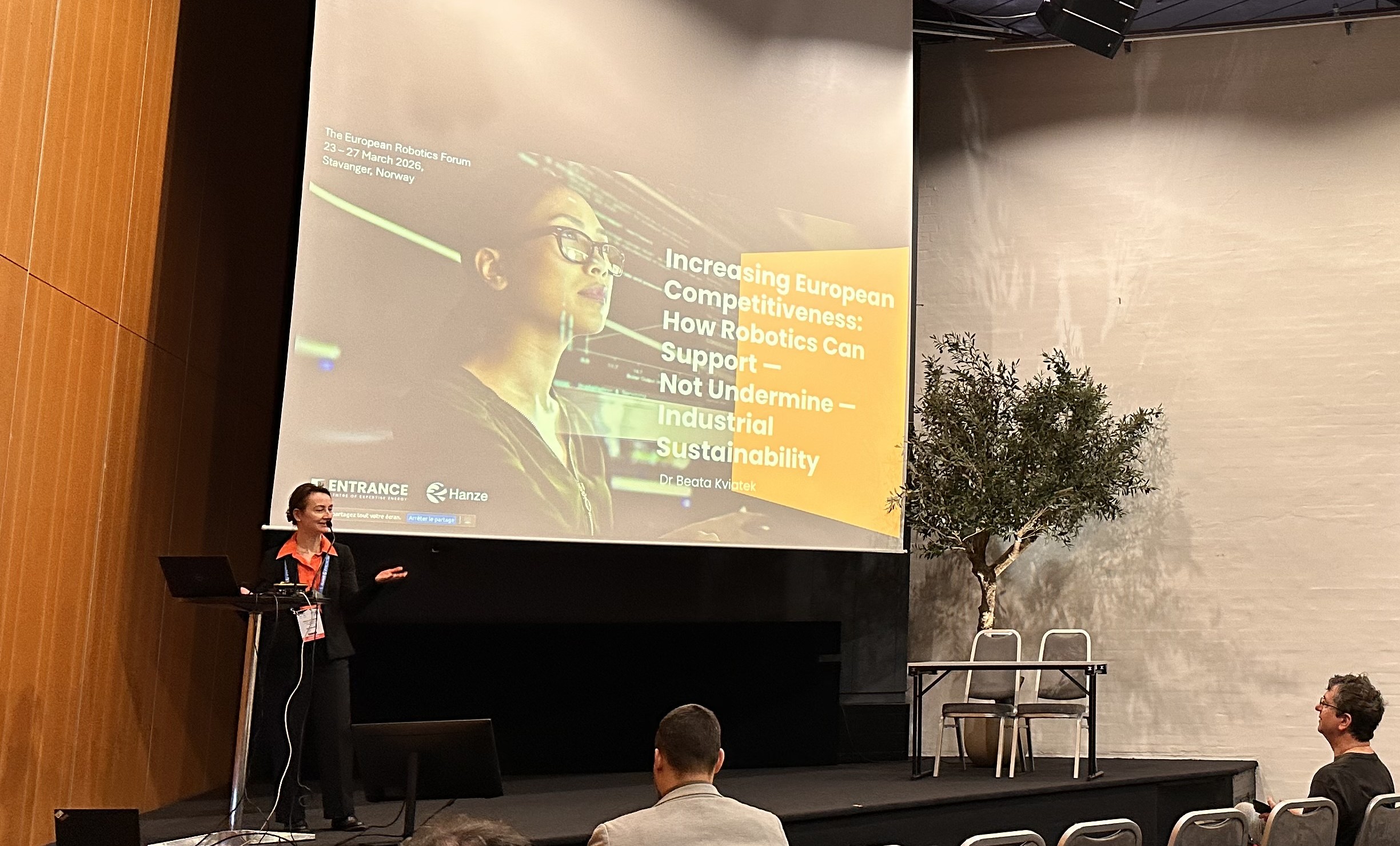
In March 2026, Dr. Beata Kviatek, Jean Monnet Chair in Sustainable EU Economy at Entrance – Centre of Expertise Energy of Hanze University of Applied Sciences, delivered an invited talk at the European Robotics Forum (ERF2026)—one of Europe’s most influential annual events in robotics and artificial intelligence. Her contribution positioned Hanze within a growing European debate on how robotics can strengthen competitiveness while supporting, rather than undermining, industrial sustainability.
ERF2026 brought together over 1,000 participants from industry, academia, research institutes, and policy bodies. Hosted this year in Stavanger, Norway, the forum focused on “Boosting Synergies between Robotics and AI for a Stronger Europe,” with a particular emphasis on robotics for the blue economy and emerging space technologies.
The programme featured leading voices in the field, including Alexandra Bech Gjørv (SINTEF), Camilla Stoltenberg (NORCE), Hedi Karray (EIC), Francesco Ferro (PAL Robotics), and Professor Oussama Khatib (Stanford University), who delivered the opening address. More than 120 workshops, an exhibition of advanced robotics technologies, B2B matchmaking, and several well-established innovation awards completed the agenda.
Dr. Kviatek contributed to the workshop “How Can the European Robotics Industry Cope with Planetary Boundaries and Resource Depletion?”, organised by Nicolas Andreff, Tamás Haidegger, and Franziska Kirstein, with support from the STARS EU alliance and the CNRS GdR Robotique. The session explored how robotics must adapt to a world facing ecological overshoot, resource constraints, and climate instability.
Speakers addressed topics ranging from robotics and planetary boundaries (Adrien Escande, INRIA) to resource-aware industrial strategies and the Spiral Economy (Luis Frölén Ribeiro, IPB). Professor Oussama Khatib also shared insights from his deep-sea robotics work, including the OceanOne and OceanOneK missions.
In her talk, Dr. Kviatek examined how Europe can pursue competitiveness while ensuring robotics contributes to sustainable industrial development. She highlighted risks such as rebound effects and resource-intensive innovation pathways, and proposed practical strategies for policymakers and researchers, including frugal approaches, low-tech complements to high-tech systems, and greater attention to resource-efficient design.
The workshop generated an engaged discussion on incentives for sustainable industry, systemic barriers to change, and the role of shareholders in enabling responsible innovation.
Dr. Kviatek expressed her gratitude to Professor Nicolas Andreff for the invitation and acknowledged the financial support of Université Marie et Louis Pasteur.
Photo: Franziska Kirstein