21 October 2026
Tania Ouariachi & Wim Elving
Societal transitions are not only technological or policy challenges, but also issues of communication and trust. Developers of wind farms, solar farms, district heating networks, mobility concepts, and other sustainable innovations are increasingly confronted with misinformation, disinformation, and highly polarizing narratives. This can reduce public acceptance of projects, erode trust in the organizations and governments involved, and ultimately lead to delays in transitions.
Within Entrance’s Communication, Behavior & the Sustainable Society (CBSS) research group, we are therefore developing a toolkit for designers of transition processes. The goal is not only to teach professionals how to correct inaccurate information after the fact, but above all to better equip them to recognize information threats early on, understand the underlying mechanisms, and respond appropriately. In its current development, the toolkit is being explicitly expanded from wind energy to include solar farms, hydrogen, district heating networks, and other transition issues.
An important scientific foundation for this toolkit is provided by Jülide Kont’s doctoral research on resilience to disinformation. Her research is affiliated with Hanze University of Applied Sciences and the University of Groningen and is part of the broader NWA HAICu project. Within HAICu, we are involved, among other things, in the work package focused on the construction of polyvocal and multimodal narratives. HAICu brings together researchers from fields such as AI, Digital Humanities, and journalism to address issues related to information, narratives, and societal meaning-making.
A key premise of this doctoral research is that disinformation research should not focus exclusively on why people believe disinformation, but also on what makes people resilient to it. In a systematic literature review of 95 empirical studies, twelve factors associated with resilience or vulnerability were identified, including thinking style, knowledge, emotions, media use, trust, worldviews, perceived control, culture, and the broader information environment (Kont et al., 2025). Moreover, these factors operate at different levels: individual, social, and societal.
This perspective is relevant to transition communication. It means that simply providing more facts is insufficient. People process information based on existing beliefs, social relationships, emotions, and trust in institutions. Effective communication therefore also requires attention to the context in which information is received.
The research also shows that emotions play a central role. Based on 29 interviews with young adults in the Netherlands and Germany, it appears that feelings of calm and trust are associated with fact-checking behavior and critical thinking. Negative emotions such as anger do not necessarily lead to greater vulnerability: when anger is accompanied by critical evaluation, it can also be part of resilience. In contrast, very strong negative emotions—such as helplessness and feeling overwhelmed—are associated with withdrawal, distrust, and greater susceptibility to disinformation (Kont et al., 2026a).
Another study within the doctoral research project maps out the everyday tactics young adults use to assess questionable information. It shows that not only individual skills are important, but also the economic, cultural, social, and personal resources people have at their disposal (Kont et al., 2026b).
These insights are being translated into a practical toolbox for professionals who design and implement transition processes. The toolbox is intended to help them, for example, to:
An essential principle here is that criticism of a transition project should not automatically be labeled as disinformation. Local residents, for example, may have legitimate concerns about the landscape, noise, decision-making, property rights, or a fair distribution of benefits and burdens. Effective communication therefore begins with listening and with carefully distinguishing between demonstrably false information and legitimate social criticism (Ouariachi & Elving, 2026).
Figure: AI representation of a toolbox for addressing disinformation
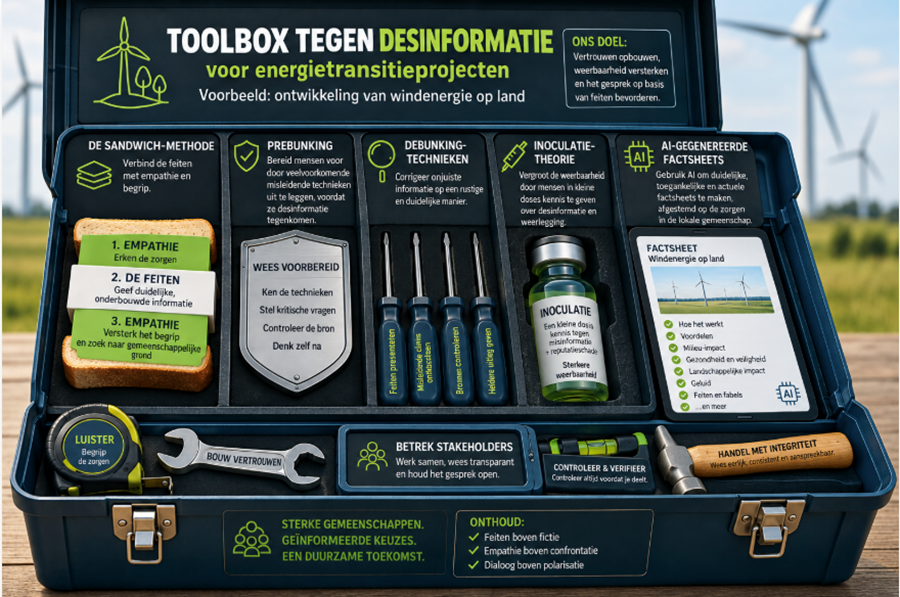
The first applications are in wind energy. For example, claims circulate around wind turbines regarding health risks, noise, birds, the reliability of the electricity supply, and alleged financial interests. Research at Hanze University shows that such narratives sometimes circulate even before a final location for a wind farm has been determined. As a result, developers sometimes begin a public participation process with an information deficit (Asadi, 2026).
Similar dynamics are evident in solar farms, for example, regarding claims about toxic substances, recycling, land use, or threats to food production. The toolbox should therefore not be technology-specific. With WarmteStad and other district heating networks, narratives can also arise regarding mandatory connection, costs, dependence on a single supplier, or alleged health and safety risks. It is precisely in such projects that existing concerns about affordability and control can become intertwined with demonstrably false information.
Another relevant area of application is the “15-minute city.” The original concept aims to ensure that daily amenities are accessible within a 15-minute walk or bike ride as much as possible. At the same time, the concept has given rise internationally to conspiracy narratives claiming that residents would be locked into their neighborhoods, that freedom of movement would be restricted, or that cities would be divided into controlled zones or even “new ghettos.” Research shows that such conspiracy theories have now become a significant factor in public resistance to the concept (Marquet et al., 2024).
The ambition of the toolkit thus goes beyond correcting individual misrepresentations. Ultimately, we aim to help transition designers develop resilient transition processes: processes that, from the outset, prioritize trust, information quality, participation, emotions, and the information environment in which citizens form their opinions.
This shifts the focus from “How do we debunk this false claim?” to a broader question: “How do we design a transition process in which people are better able to find reliable information, weigh different perspectives, and resist manipulative information?” It is precisely this translation of scientific knowledge about resilience to disinformation into concrete practical strategies that forms the core of the toolkit.
Asadi, D., (2026). Disinformation as a Barrier to Public Acceptance of Onshore Wind Energy in the Netherlands. A Qualitative Study of Vattenfall. In: W.J.L. Elving (ed.). Breaking Barriers, Research Studies to Accelerate Transitions. Groningen: Entrance.
Kont, J., Elving, W. J. L., Broersma, M., & Bozdağ, Ç. (2025). What Makes Audiences Resilient to Disinformation? Integrating Micro, Meso, and Macro Factors Based on a Systematic Literature Review. Communications, 50(2), 534–555. https://doi.org/10.1515/commun-2023-0078
Kont, J., Bozdağ, Ç., Elving, W. J. L., & Broersma, M. (2026a). So emotional? The role of emotions in young adults’ resilience to disinformation. Media and Communication, 14, Article 11398. https://doi.org/10.17645/mac.11398
Kont, J., Bozdağ, Ç., Elving, W. J. L., & Broersma, M. (2026b). Understanding young adults’ resilience to disinformation: A cross-national analysis of daily tactics and resources to navigate information. New Media & Society. Advance online publication. https://doi.org/10.1177/14614448261458283
Marquet, O., Mojica, L., Fernández-Núñez, M.-B., & Maciejewska, M. (2024). Pathways to 15-minute city adoption: Can our understanding of climate policies’ acceptability explain the backlash toward x-minute city programs? Cities, 148, 104878. https://doi.org/10.1016/j.cities.2024.104878
Ouariachi, T. & Elving, W.J.L. (2026). Combating Renewable Energy Delayism and Misinformation: A Strategic Communication Toolbox Proposal for Transition Developers. Paper presented at the Euprera conference, Málaga, Sept. 14–18.