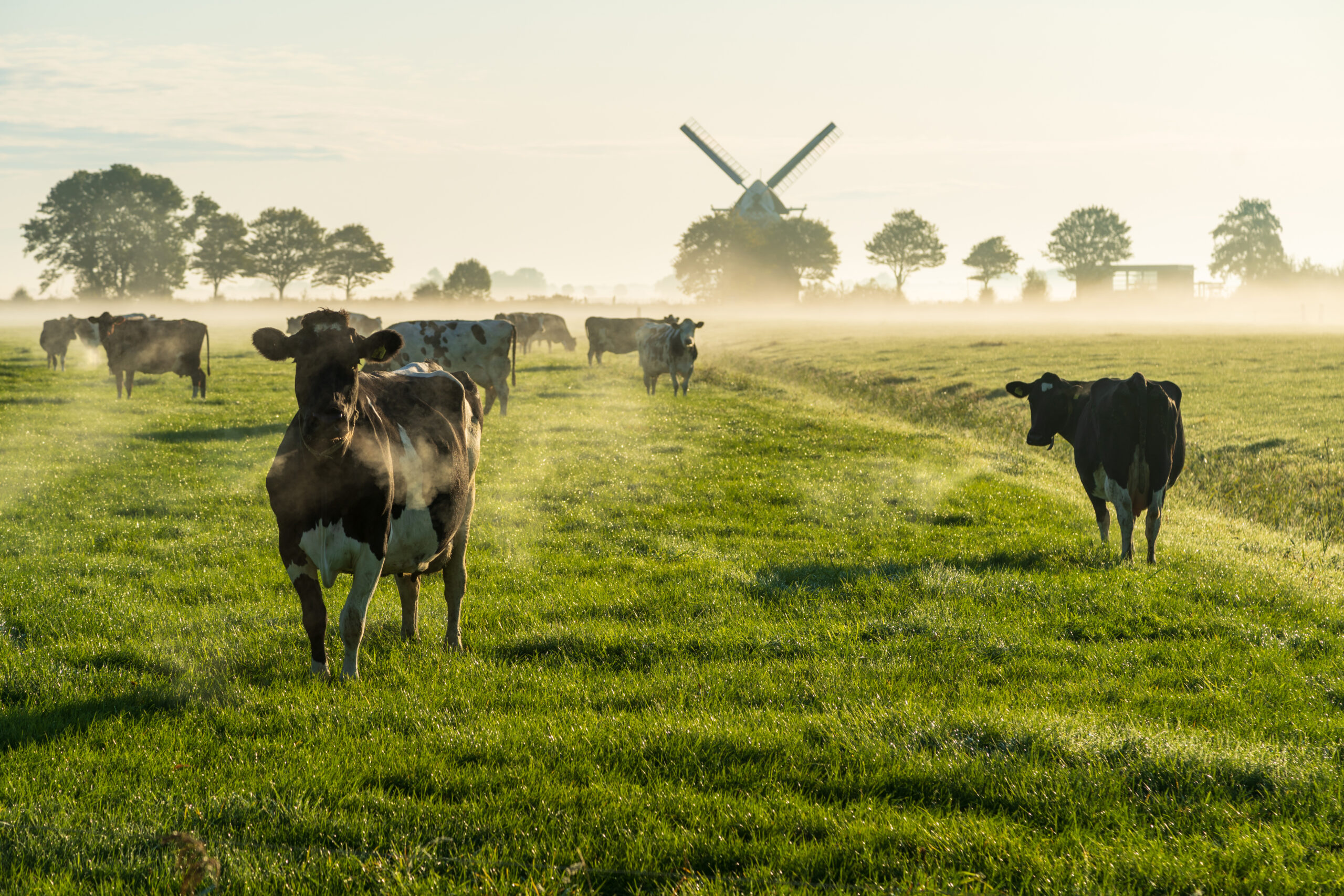
Convert grass and other local biomass into green gas.
Watts in Grass?! is an ambitious cross‑border innovation project that brings together Dutch and German partners to transform low‑value grass streams into renewable energy, valuable bio‑based products, and circular nutrients. The project demonstrates how farmers can convert grass, roadside cuttings and other local biomass into green gas, biochar, volatile fatty acids and sustainable fertilizers, leading to both economic and sustainable benefits.
Agriculture in the Dutch–German border region faces major challenges, from rising energy costs and stricter environmental rules to nitrogen restrictions, methane emissions and the pressure to reduce fertilizer use. At the same time, large volumes of biomass remain underused, in particular grass.
Watts in Grass?! offers a future‑proof solution: a decentralized biorefinery concept where farmers convert their own residual streams into clean energy and circular resources, reducing dependence on fossil fuels, artificial fertilizer and the overloaded electricity grid.
The primary objective of the project is to develop an integrated biorefinery system built around four complementary technologies.
Together, these technologies create a closed, circular system where carbon, nutrients and energy remain on the farm rather than being lost as waste.
The project is carried out jointly by Dutch and German partners, because both regions face similar agricultural, environmental and energy challenges. Germany brings long‑standing experience with biogas installations, while the Netherlands leads in circular agriculture and technological innovation. Demonstrations take place on a farm in Bad Bentheim (DE), supported by Dutch research and pilot facilities. This cooperation accelerates regional learning and ensures that the system works under a variety of regulatory and practical conditions.
By the end of the project, Watts in Grass?! will deliver a fully validated, integrated biorefinery model for turning grass into energy and high‑value products. We also closely collaborate with industry parties to deliver a full-scale application of Trickle Bed Reactor in a farm. The project demonstrates how biological and thermochemical processes can be combined to significantly increase biogas yields, reduce CO₂ and nitrogen emissions, and create renewable alternatives for fossil‑based products.
The pilot systems will remain operational as long‑term testing and demonstration sites, enabling ongoing innovation and scale‑up by regional businesses. With this foundation, the project supports new circular business models for agriculture, strengthens regional earning capacity and contributes directly to European goals for climate‑neutral, resource‑efficient farming.
As one of the four research institutes in this project, Entrance develops and validates the Trickle Bed Reactor in its REMO lab and supports its scaling to a full pilot installation on a farm. Entrance also conducts applied research on the Artificial Rumen Reactor and the digestate electrolysis system for sustainable hydrogen production. Through technical validation, process modelling and scientific support, Entrance contributes to the creation of an integrated biorefinery concept that enables farmers to convert their own residual biomass streams into renewable energy and circular products.
Watts in Grass?! is designed for farmers, biogas operators, technology developers and policymakers looking for scalable solutions for circular energy and nutrient management. Farmers gain new revenue streams from green gas, VFAs and biochar, while reducing emissions and fertilizer costs. Technology suppliers benefit from a validated, farm‑scale concept with strong market potential. Policymakers receive practical examples of how circular agriculture can contribute to climate, nitrogen and biodiversity goals.
The project Watts in Grass!? is carried out under the Interreg VI-programme Deutschland-Nederland, and is co-financed by the European Union, the Dutch Ministry of Economonic Affairs, Niedersächsische Staatskanzlei as well as the provinces Groningen, Fryslân and Overijssel with a sum of €2,940,156.78.
Duration: February 2026 – May 2029
Total project budget: € 4.377.909,80
Budget Entrance: € 758.765,00
Location: The Netherlands and Germany
Partners: New Energy Coalition, Kompetenzzentrum 3N, Hochschule Emden/Leer, Hochschule Osnabrück, Ekwadraat, Schulte Siering, BTG Biomass Technology Group, Pagues.
Themes:
Renewable Fuels and Sustainable Gas
Industrial Transformation
Local and regional energy strategies
Professorships involved:
Sustainable gases and fuels
Life Sciences and renewabe energy
Bioconversion and fermentation technology (Knowledge Centre Biobased Economy)
H2Business helps energy-intensive small and medium-sized enterprises explore hydrogen, hydrogen carriers, and other sustainability pathways.
H2Business helpt energie-intensieve mkb bij het onderzoeken van waterstof, waterstofdragers en andere verduurzamingsroutes.
Hoe communiceer je overtuigend en effectief over duurzame innovaties in een samenleving waarin polarisatie, wantrouwen en desinformatie toenemen?