3 November 2026
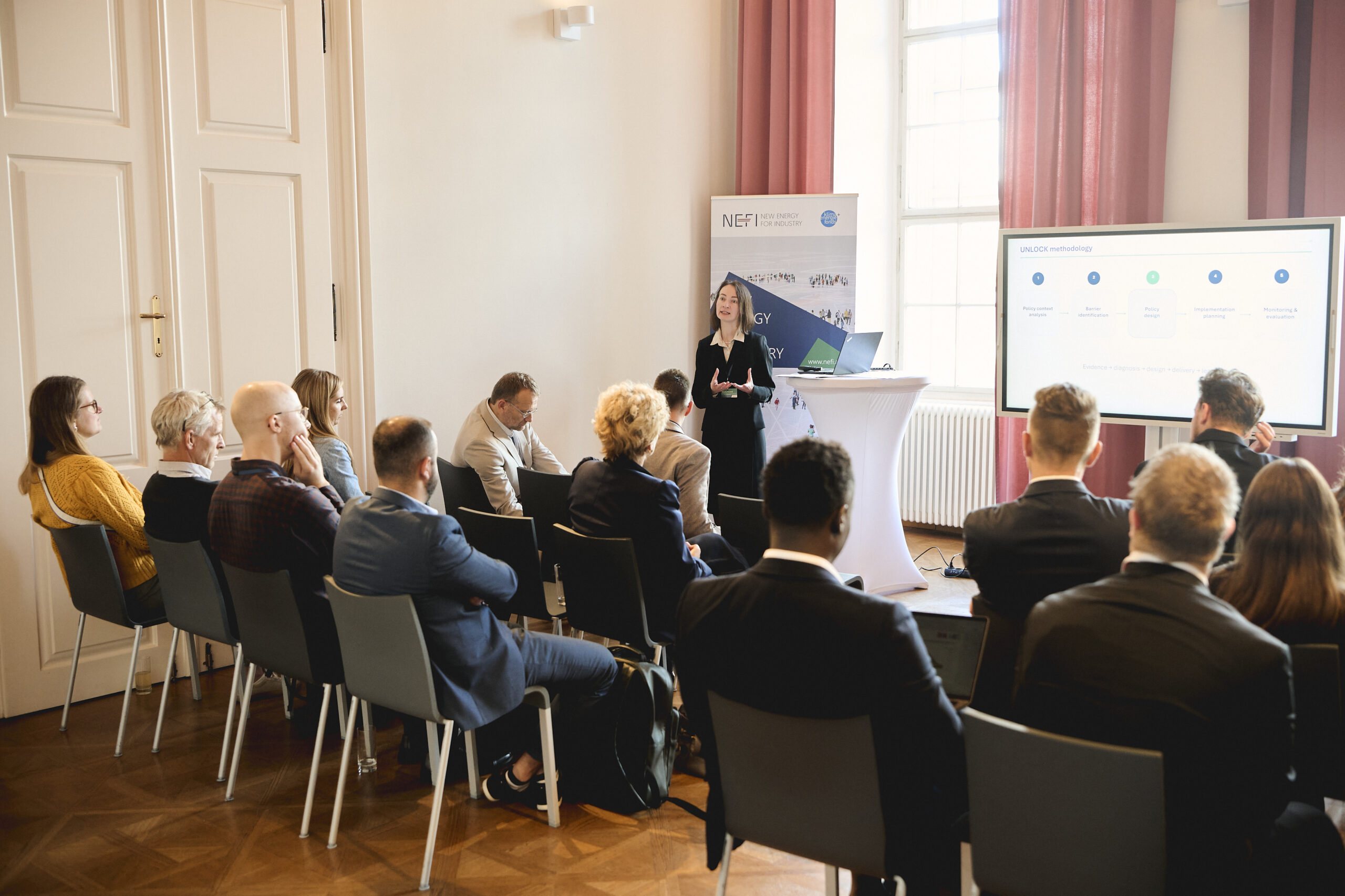
On 22 and 23 October 2026, Beata Kviatek, Jean Monnet Chair at Hanze University of Applied Sciences, presented research from the Interreg Europe UNLOCK project at the fourth NEFI Conference in Vienna. UNLOCK research presented at NEFI Conference 2026 shows how policymakers can remove barriers to SME participation in hydrogen value chains through four practical, transferable policy models.
Held at Museums Quartier under the theme “Future Industry – Innovating for Competitiveness,” the conference brought together around 200 representatives from industry, research and policymaking across 14 countries. Through 13 thematic sessions and approximately 80 scientific presentations, participants explored how technologies can be scaled, enabling policy frameworks strengthened and investment mobilised to support a competitive, climate-neutral industry.
In the session “Sustainable Hydrogen Value Chains, Applications and Policy,” Kviatek presented the paper “A Policy Improvement Methodology for Strengthening SME Participation in Regional Hydrogen Ecosystems.” The research addresses an important gap in the hydrogen transition: while considerable attention has been given to hydrogen technologies, infrastructure and markets, less focus has been placed on the policy conditions that allow small and medium-sized enterprises to participate in emerging hydrogen value chains.
Research conducted through UNLOCK across seven European Hydrogen Valleys identified four recurring barriers to SME participation:
The UNLOCK Policy Improvement Methodology helps regional policymakers and ecosystem stakeholders analyse these barriers and translate them into targeted, implementation-oriented policy responses. It combines regional stakeholder co-creation with interregional policy learning and benchmarking, ensuring that the proposed solutions reflect practical experience from different European regions.
Stakeholders assessed potential policy instruments according to their expected impact, feasibility, acceptance and transferability. This process resulted in four transferable policy models:
The research demonstrates that successful hydrogen ecosystems depend not only on technological readiness. They also require governance arrangements that reduce fragmentation, improve access to information and finance, connect innovation with market opportunities, and enable SMEs to collaborate within emerging industrial value chains.
This message closely reflected the wider discussions at the NEFI Conference. The event highlighted that industrial decarbonisation is both a technological and a systemic challenge, requiring coordinated economic, political and regulatory conditions. Stable policy frameworks, targeted research and development funding, and demonstration and investment projects were identified as essential for moving innovations towards practical implementation.
By bringing the UNLOCK methodology to this international scientific forum, the presentation demonstrated how interregional cooperation can generate practical policy instruments for regional hydrogen ecosystems. It also reinforced the role of SMEs as active participants in industrial transformation, rather than simply as users of technologies developed elsewhere.
The paper is published in the Proceedings of the 4th NEFI Conference 2026. The proceedings bring together research and practical applications addressing the technological, economic and regulatory conditions needed for a competitive and climate-neutral European industry. They were published on 22 October 2026 and are openly accessible through Zenodo: zenodo.org
Picture: AIT/APA-Fotoservice/Martin Hörmandinger