27 februari 2026
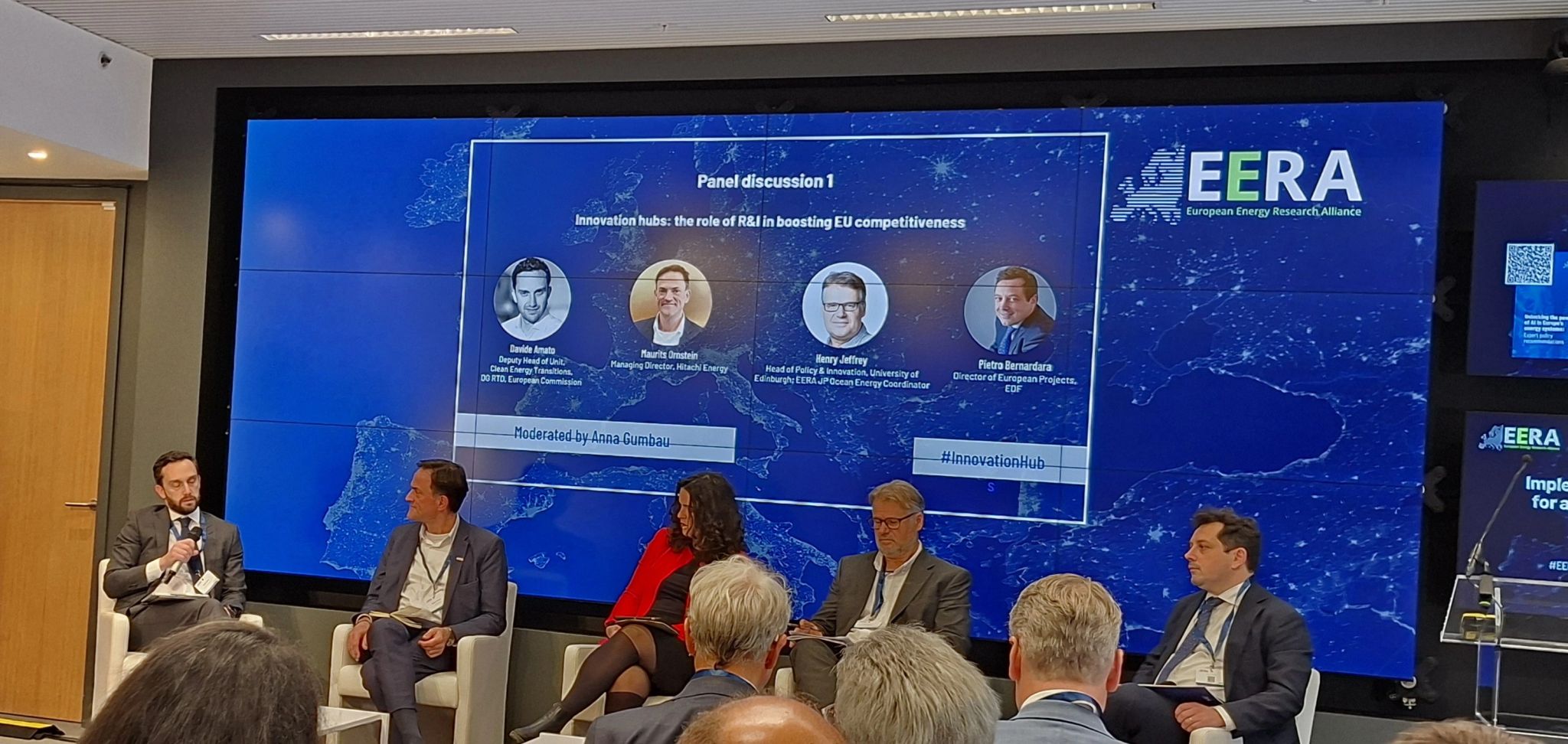
The EERA High-Level Policy Conference on 3 December 2025 brought together a broad cross-section of Europe’s research, policy and industry communities. Months later, the themes discussed there remain central to debates on Europe’s competitiveness and the direction of the energy transition in 2026. The focus on innovation hubs, artificial intelligence, and resilience was well chosen: these are the strategic levers where Europe’s long-term decisions will have the greatest impact.
Conference discussions highlighted innovation hubs as essential infrastructures for bridging the gap between research excellence and industrial uptake. Their contribution to derisking investments—by reducing technological uncertainty, accelerating learning and fostering collaboration—was rightly emphasised.
In my contribution, I added a complementary perspective: innovation hubs alone cannot derisk Europe’s energy transition. Many of the risks investors face lie outside the technological domain and beyond the reach of any hub, including:
Even the most advanced hub cannot compensate for fragmented permitting, shifting regulatory frameworks or volatile demand signals. Hubs thrive when embedded in a stable, strategically aligned environment. Without this, we risk placing unrealistic expectations on them—treating hubs as if they can solve challenges that are fundamentally political and institutional.
Strengthening the policy frameworks around hubs is therefore essential. This is not about diminishing their role, but about enabling their impact to fully materialise.
The session on AI captured both the promise and the complexity of integrating advanced digital tools into Europe’s energy systems. AI can be transformative—optimising grids, enabling flexibility and supporting low-carbon system design. The EERA reports rightly stress the need for coordinated governance to ensure transparency, safety and interoperability.
My intervention addressed a subtle but important risk: the temptation to treat AI as a source of certainty in inherently uncertain domains. AI can support decision-making, but it cannot replace political prioritisation, institutional capacity or societal deliberation. Europe must avoid drifting into technological utopianism, where digital tools are expected to compensate for structural governance challenges.
A constructive way forward is to embed AI within robust institutional processes, ensuring that it enhances—rather than substitutes—strategic judgement.
The resilience track underscored the urgency of integrating preparedness into Europe’s energy transition strategy. As climate impacts intensify and geopolitical volatility grows, resilience must become a design principle rather than an afterthought.
My contribution challenged a common assumption: that resilience can be achieved by securitising everything—capacity, money, time. This creates an illusion of control that no complex system can deliver. A more realistic and effective approach begins with prioritisation:
Resilience is not about building a fortress. It is about making informed, transparent and legitimate choices about what to protect, when and why. It is a governance challenge that requires prioritisation and political legitimacy. Attempting to secure everything leads to securing nothing well.
Across all three themes, a common thread emerged. Europe does not lack research excellence, technological capability or financial instruments. What it needs most is stronger strategic decision-making—coherent, timely and aligned with long-term objectives.
The real bottleneck is not the absence of tools, talent or funding. It is the difficulty of making consistent, long-term decisions in a complex and rapidly changing environment. If Europe wants to strengthen its competitiveness and accelerate its energy transition, it must improve the quality, speed and consistency of decision-making. Innovation infrastructures matter, but they cannot carry the burden of governance.
A constructive path forward includes:
These are not additional layers of complexity; they are the enabling conditions that allow innovation hubs, AI systems and resilience strategies to deliver their full value.
Europe’s research community is ready to contribute. The challenge now is to translate this expertise into decisions that shape a competitive, secure and sustainable future. How Europe chooses to act on these insights will determine the trajectory of its energy transition in the decade ahead.