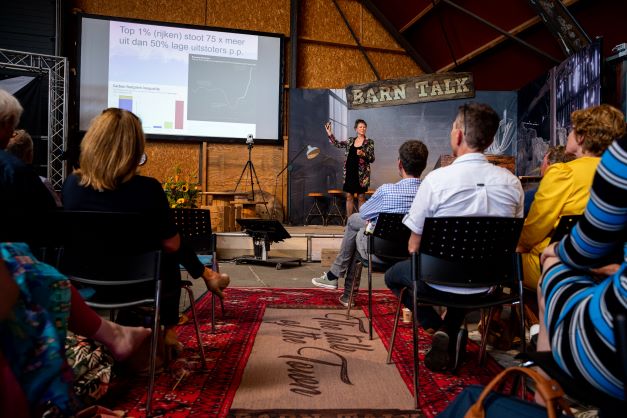
Working together towards energy-positive neighbourhoods: a look back at the EmPowerED consortium dayDuring the EmPowerED consortium meeting on 7 April, researchers and industry partners gathered at the Energy Barn. Marten van der Laan, Professor of Systems Integration, hosted the day. A large group of PhD candidates presented their diverse research questions, ranging from social participation and governance to technical models, data integration and the development of resilient Positive Energy Districts. The diversity of perspectives clearly demonstrated just how broad and complex the PED challenge is. The presentations were followed by a guided tour of WarmteStad, where the latest developments in heat networks were explained. The day concluded with a workshop on the challenges Groningen faces in the development of energy-positive neighbourhoods. A valuable and inspiring event for everyone working on the energy transition. Entrance and the Grotius Programme UniteThis academic year, Entrance acted as the commissioning body for Hanze University’s Grotius Programme. The Grotius Programme is a preparatory course for status holders with a refugee background who wish to study in Dutch higher education. The Grotius students were tasked with researching energy-saving measures in homes and the role that people’s behaviour plays in this. To this end, they not only conducted desk research but also interviewed residents of homes built in different periods.
The participants presented the results of their research on 15 April at the Energy Barn. The general conclusion: sustainability measures such as solar panels and insulation alone are not enough; encouraging sustainable behaviour is also important for saving energy. To this end, one of the groups created a memory game featuring small behavioural changes to save energy, which is also suitable for teaching young children sustainable behaviour. In addition to the memory game, attendees could also play the We-Energy Game to explore the energy transition in a playful way.
Published: The Allure of ControlLecturer researcher Wouter Swart Ranshuysen has recently written an article about the question of where true robustness in technical systems originates. Using an everyday example – modern cars packed with sensors and correction systems – he shows how stability is increasingly being “enforced” through active control, rather than being built into the system architecture itself. He argues for designs that display understandable and stable behavior even without continuous correction. The article encourages critical reflection on the balance between architecture and correction in contemporary technical systems.
Read the full article here.
Published: So Emotional? The Role of Emotions for Young Adults’ Resilience to DisinformationPhD candidate Jülide Kont studies how people develop resilience to disinformation, with a particular focus on the role of emotions. While disinformation is often framed as a problem of facts and rational judgment, her research shows that emotions are a central and often underestimated part of how people navigate misleading information.
In a cross national study among young adults, Jülide examines when specific emotions arise, how they relate to behavior, and how they contribute to resilience. Rather than merely increasing vulnerability, her findings demonstrate that emotions can play a constructive role in recognizing, questioning, and resisting disinformation.
Read the full article here.
PUBLISHED: New publications from the Research Group on Legal and Economic Issues in the Energy TransitionWithin the Legal and Economic Issues in the Energy Transition research group, several reports have recently been published on the legal frameworks surrounding hydrogen safety and the development of hydrogen infrastructure. These publications form the first deliverables within the Hy‑SUCCESS project (GroenvermogenNL), in which the research group is developing an ICT tool that will clarify safety and environmental standards to help accelerate permitting procedures.
The first report, written by Daisy G. Tempelman and Joris C.W. Gazendam, provides an overview of international and European safety standards for hydrogen applications. The second report, authored by J.C.W. Gazendam, K. Hofman Filadoro and M. den Uijl, focuses on the Dutch context and the application of these standards within permitting processes. Click here for the first article and click here for the second article.
In addition, within the H2opper project a legal report has been published on the development of a hydrogen hub in Delfzijl. This report, prepared by J.C.W. Gazendam and D.G. Tempelman, analyses the relevant legal aspects related to hydrogen networks, production, transport and distribution.
Read the article here. PUBLISHED: Balancing the Energy System: Simulating a Multi-Commodity Approach to Enhance Biomethane Injection Capacity in Gas NetworksIn addition to the earlier reports, a new article has been published by researcher lecturer Sander Dijk and ENTRANCE lecturers Marten van der Laan and Joàn Teerling. Their study examines how surplus biomethane can be used to reduce bottlenecks in gas and electricity distribution networks.
Read the full article here.
Serious Games at Entrance AND HanzeSerious Games are gaining momentum at both Entrance and the Hanze University of Applied Sciences. The events organized by SAGANET are therefore particularly relevant.
A quick look back: the Rookie Award event was a seminar in which various serious games were played on a wide range of topics. These games demonstrated how play can help create insight and overview in complex subjects and systems.
Read the full article here. Launch of the TEC CampusOn Tuesday, April 14, the TEC Campus was officially launched! During the opening of the Technology, Energy and Circularity Campus, lecturers and companies came together to discuss plans for the coming period. On behalf of Entrance, Sjoerd de Vries spoke and introduced the KETEN project.
To drive the energy transition forward, we need well trained professionals. With the KETEN project, we aim to boost the labor market in collaboration with knowledge institutions and industry partners.
|