5 oktober 2026
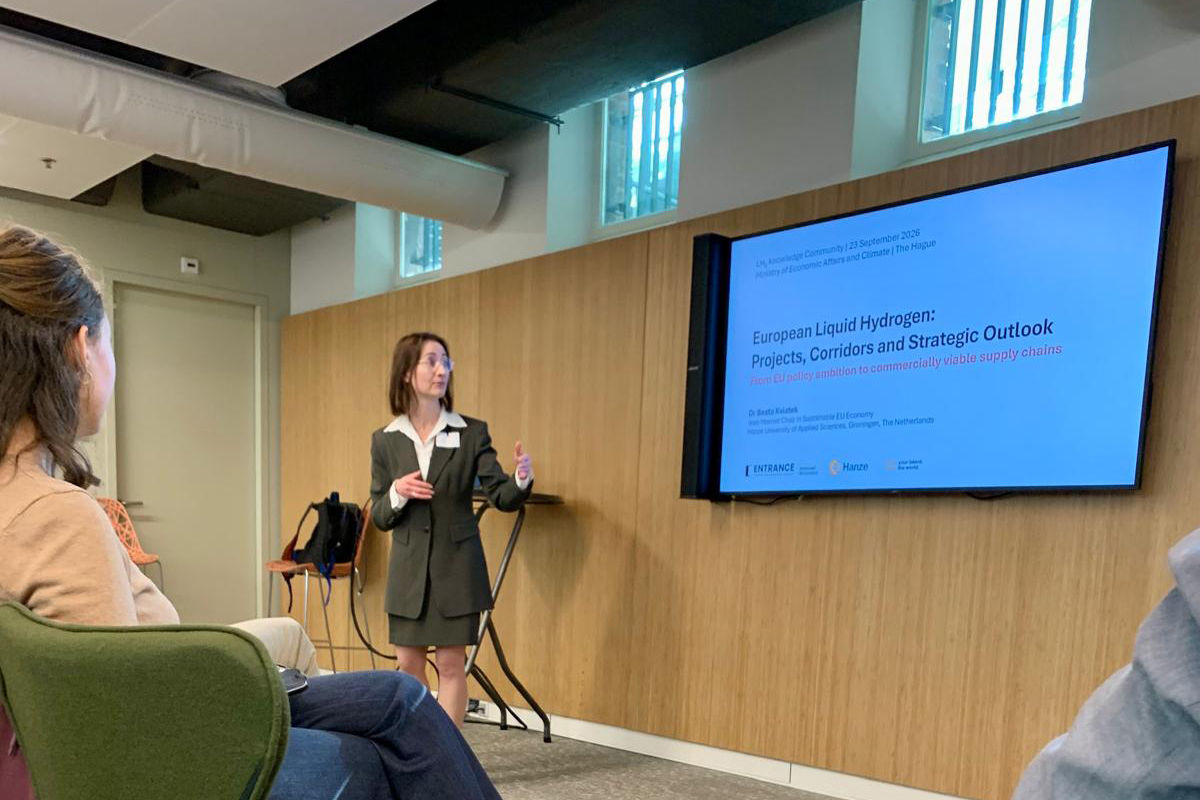
Dr Beata Kviatek, Jean Monnet Chair in Sustainable EU Economy at Hanze University of Applied Sciences, presented her strategic outlook on European liquid hydrogen to the LH₂ Knowledge Community at the Ministry of Economic Affairs and Climate in The Hague on 23 September 2026.
In her presentation, European Liquid Hydrogen: Projects, Corridors and Strategic Outlook, Dr Kviatek argued that Europe’s next priority should be to move beyond project announcements and build a small number of complete, commercially credible supply chains. These must connect hydrogen production, liquefaction, transport, terminal infrastructure, inland distribution and committed demand.
Europe already has considerable technical expertise in liquid hydrogen, including production, cryogenic storage, transport and specialised applications. The main challenge is connecting these capabilities into supply chains that can attract investment and deliver hydrogen reliably at an acceptable cost.
Liquid hydrogen could play a valuable but selective role in ports, aviation, maritime transport and other specialised applications. Its commercial viability will depend on binding demand, adequate infrastructure utilisation and coordinated commitments from producers, ports, investors and users.
The message is particularly relevant to the Northern Netherlands, with its combination of energy expertise, industrial activity, ports, knowledge institutions and access to North Sea energy networks. Dr Kviatek recommended prioritising integrated port-cluster projects with credible demand and distribution plans. Progress should be measured through binding offtake agreements, investment decisions, first deliveries, throughput, asset utilisation and delivered cost, rather than by the number of project announcements.
Dr Beata Kviatek is Jean Monnet Chair in Sustainable EU Economy at Hanze University of Applied Sciences. Her wider work addresses European sustainability policy, the energy transition and the conditions required to move emerging technologies from policy ambition to viable implementation. She is also Project Leader of the Interreg Europe project UNLOCK: Unlocking Green Hydrogen Economy for SMEs in European Regions.